What does it mean to truly work in a data-driven way?
In this blog, we'll explain what data-driven working really entails.
Every organisation wants to be it: data-driven. It sounds logical in an era where data is everywhere and technology offers many possibilities. Yet, in practice, being data-driven proves difficult for many organisations to translate into daily reality.
But what does it actually *really* mean to be data-driven? Is it a data lake in the cloud? A dashboard full of KPIs? Or does it start somewhere else?
In this blog, we explain what data-driven working entails, where organisations often get stuck, and how you can smartly take steps towards a culture where data is central – without it needing to become a massive technical project.
Data-driven working is more than technology
Although technology is indispensable, the core of data-driven working lies in human behaviour and decision-making. An organisation is only truly data-driven when data is an inherent part of how it thinks, is managed, and acts.
It means:
- That decisions are made based on facts rather than assumptions
- That employees rely on data because it is reliable, up-to-date, and available
- That there is room to learn from analyses, mistakes, and patterns
Technology is supportive in this – not leading.
The biggest pitfall: thinking in tools, not in goals
A common pitfall is starting with a tool rather than a question. Consider organisations that invest in dashboards or AI models without it being clear what they want to improve, speed up, or predict.
This leads to frustration, low adoption, and data systems that function perfectly well technically, but yield little value in terms of content.
A good data strategy therefore doesn't start with technology, but with the question: “Which decisions do we want to base better?”
The three building blocks of a data-driven organisation
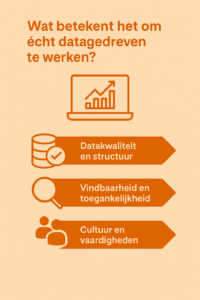
Do you *really* want to make data-driven working a success? Then these are the three essential pillars:
You can only rely on data if it is complete, up to date and unambiguous. Among other things, this means:
1. Data Quality and Structure
- One central source of truth
- Smart data structures (consider tagging, logging, consistency)
- Avoiding data silos
2. Findability and accessibility
Data must be available to the people who need to work with it. Whether it's a manager, customer service representative, or policy advisor: information must be easily accessible, searchable, and usable.
3. Culture and skills
Data only becomes valuable if people dare to work with it and are able to. This requires:
- Leadership driven by insights
- Staff who know how to interpret data
- A culture in which experimentation and improvement are encouraged
Start small, think big
You don't need to completely overhaul your data architecture straight away. Start with a concrete goal: for example, better understanding customer behaviour, accelerating internal processes, or identifying incidents earlier. Choose a relevant use case, map out the appropriate data, and work step by step towards broader application.
This is how data-driven working emerges not as a project, but as a mindset.
Do you also want to become truly data-driven? We'd be happy to help.
At PuurData, we help organisations turn their data strategy into practical applications. From structuring data to making it searchable and analysable – always with a focus on simplicity, reliability and results.
Download ours Guide to smart data strategies, or plan a No-obligation consultation with one of our data specialists.
Want to know more?
Would you like to know more or do you have questions about the possibilities? Call us on +31 (0)88-7887328, visit our Contact page, fill in the form below!
Recent news reports